
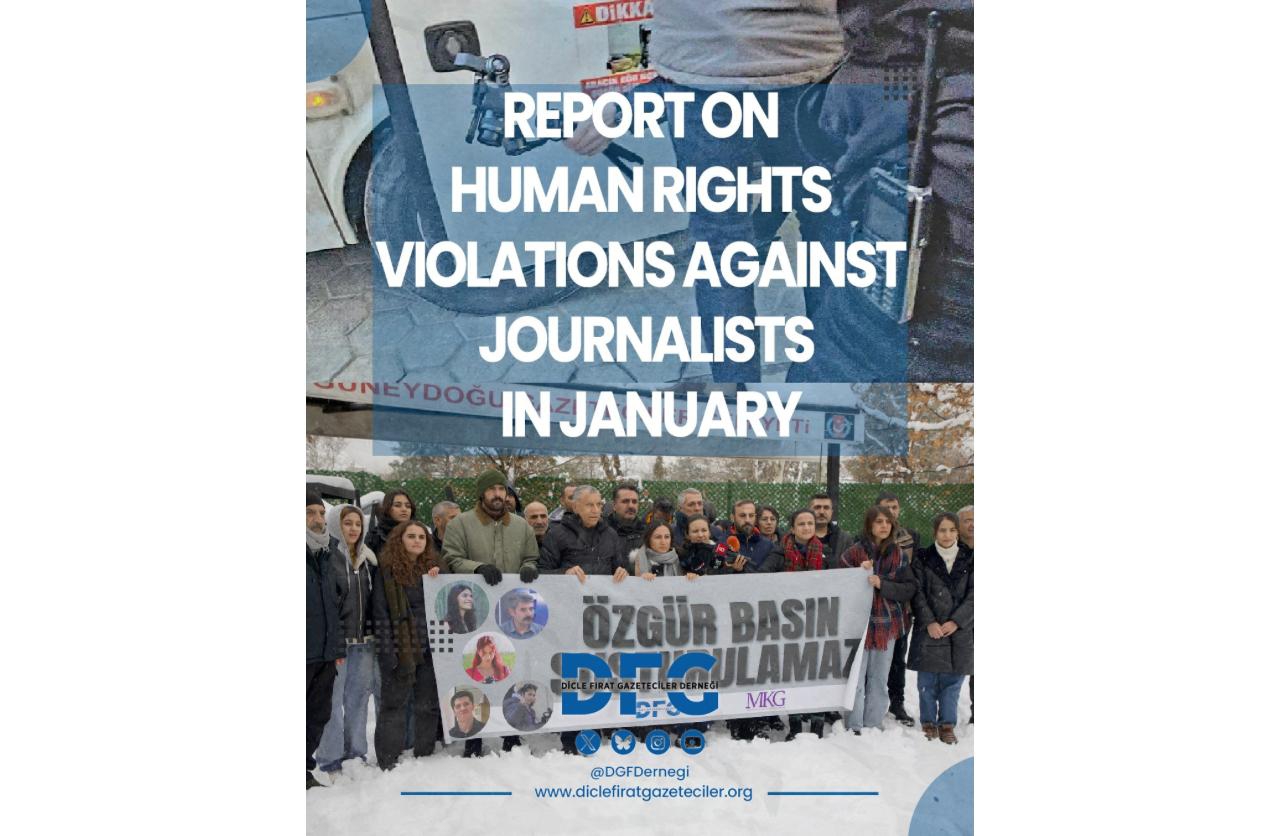
JANUARY ASSESSMENT OF VIOLATIONS AGAINST JOURNALISTS’ RIGHTS
With the beginning of the year, violations of press and freedom of expression continued. In January, serious increases in violations against journalists were observed alongside the government’s insistence on war policies and the attacks targeting Rojava.
From 6 January onward, when the attacks intensified, while HTS attacks against Kurdish regions increased, violations against press freedom in Türkiye also escalated. Unlawful interventions were carried out against protests organized in many cities in response to the attacks on Rojava, and journalists covering these interventions were directly targeted.
On 14 January, Ajansa Welat reporter Nedim Oruç was beaten by police and taken into custody while covering news in the Cizre district of Şırnak province, and was subsequently arrested on 17 January. During the same period, reporters from Mezopotamya Agency and Jinnews were repeatedly subjected to police violence.
Our Co-Chair Kesira Önel, along with journalists Ferhat Akıncı, Pelşin Çetinkaya, Muhammed Ali Yılmaz, and Heval Önkol, who were following developments in Nusaybin, were beaten and taken into custody; their cameras were damaged and their equipment was arbitrarily confiscated. Journalists Ahmet Kanbal, Şirin Bayık, Ensar Özdemir, Bilal Güldem, and Mahsun Kara, who attempted to record the detention of their colleagues, were subjected to physical violence.
In the Suruç district of Urfa province, ANKA reporter Ahmet Ün was struck by a tear gas canister fired by police while covering events. During the same protest, journalist Metin Yoksu was injured after a tear gas canister hit the left side of his head and was taken to hospital.
Journalist Bekir Şeyhanlı was injured after being hit by an armored vehicle. Similar violations occurred in Van, where the news coverage of many journalists was obstructed, and journalist Kadir Cesur was targeted with a plastic bullet.
Attacks against journalists were not limited to physical violence. The digital accounts of numerous media outlets and journalists were arbitrarily blocked. Access was restricted to 39 social media accounts that reported on HTS attacks against Rojava. Of these accounts, 23 belonged to journalists and 16 belonged to news agencies, newspapers, and television channels. According to data from the Independent Data Journalism Platform, the blocked accounts had a total of 640,000 followers, and their content had reached 232 million views.
During the same period, the websites of Mezopotamya Agency and Jinnews were blocked, and their digital media accounts were each restricted three times. In the first month of the year, 3 websites were shut down, access bans were imposed on 23 news articles, and 458 social media accounts and pieces of content were censored. These practices are directed not only at journalists but directly at the public’s right to access information.
In January, 14 journalists were taken into custody, and one journalist was arrested. During the same month, three journalists were directly threatened, and 22 journalists were prevented from carrying out news coverage. This situation clearly demonstrates that journalists’ right to life and personal security is under direct threat.
Violations of freedom of thought and expression also continued to increase in January. According to January data, one journalist was subjected to an investigation, one journalist was put on trial, and three journalists were sentenced to a total of 3 years, 9 months, and 7 days in prison. Trials against 61 journalists in 29 cases are ongoing, and as of 3 February 2026, the number of journalists currently imprisoned stands at 26.
In January, censorship in the internet and digital media sphere became normalized, and direct interventions were carried out against the public’s right to receive information. Press and freedom of expression are fundamental conditions of a democratic society. Policies that criminalize journalism are unacceptable. Pressure and violence against journalists must end, detained journalists must be immediately released, and censorship and access bans must be lifted.
We reiterate once again: journalism is not a crime. We will continue to defend the truth.
DICLE FIRAT JOURNALISTS’ ASSOCIATION