
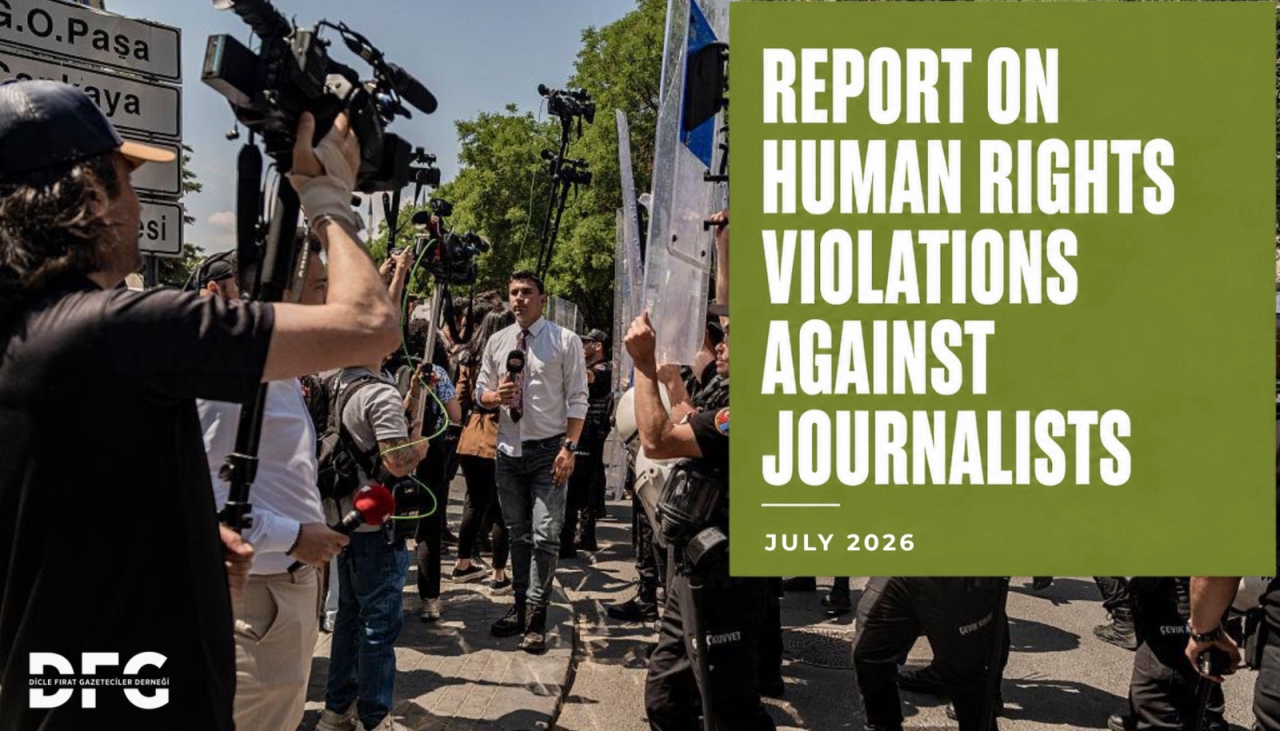
JULY 2026 REPORT ON HUMAN RIGHTS VIOLATIONS AGAINST JOURNALISTS
July was a month in which pressure on press and freedom of expression in Turkey intensified and continued. Journalists were detained, arrested, threatened, and subjected to legal proceedings because of the news they reported, their social media posts, and their journalistic activities. In particular, the operations carried out ahead of the NATO Summit, the obstacles journalists faced while covering the news, and access restrictions on digital platforms demonstrated that the crackdown on press freedom continues in various forms.
In July, 12 journalists—including Cumhuriyet reporter Gülnur Saydam, journalist Fatma Sibel Gürcihan, T24 editor Buse Söğütlü, Odatv editor Ceren Erdoğdu, Niha+ reporter Abbas Vural, Azadîya Welat Editor-in-Chief Berfin Ay, journalist Hazar Dost, BirGün reporter Kayhan Ayhan, DW Türkçe reporter Alican Uludağ, and journalists Ali Taş, Fermandar Kardaş, and Cem Küçük were among the 12 journalists detained.
It was notable that the journalists’ news reports, social media posts, and past participation in protests were cited as grounds for their detention. Of the 12 detained journalists, Fatma Sibel Gürcihan and Cem Küçük were arrested.
One of the most notable developments in July was the series of operations carried out ahead of the NATO Summit held in Ankara on July 7–8. During these operations, T24 foreign news editor Buse Söğütlü, Odatv editor Ceren Erdoğdu, and Niha+ reporter Abbas Vural were detained. During the same period, journalist Hazar Dost was also taken into custody. Dost stated that he was subjected to mistreatment during his detention, was not allowed to use the restroom, was denied the medication he takes regularly, was subjected to insults and profanity in the police vehicle, and was physically assaulted while being transported to the courthouse. Journalists covering the protest held at Kurtuluş Park on July 7 to protest the NATO Summit were also affected by the police intervention. While police used shields to block the view of media representatives and protesters in order to prevent filming, journalists working in the area were removed from the scene and barred from taking footage. This incident was recorded as a direct interference with journalists’ right to cover public events and inform the public. In July, the detention of journalists and the initiation of investigations against them due to their social media posts also continued. The trials of 33 journalists in 14 cases continued. Numerous court hearings were held in July for cases in which journalists were on trial. While the acquittal and release of some journalists during the month were noted as positive developments, the postponement of many journalists’ trials to later dates and the continuation of judicial control measures revealed that judicial processes continue to exert pressure on journalists.
Meanwhile, journalist Aslıhan Gençay was acquitted, and BirGün reporter Sarya Toprak was also acquitted in the case in which she was being tried for a news story she had reported. Release orders were issued for ETHA reporters Müslüm Koyun and Yıldız Tar. A report by BirGün newspaper reporter Ebru Çelik alleging that extras were brought in for the CHP’s badge-pinning event also became the subject of pressure in July. While Çelik was threatened, an investigation was launched against her. As part of the same investigation, BirGün Web Coordinator Uğur Koç and Berkant Gültekin were also summoned to give statements. Journalists Fatih Altaylı and Timur Soykan also gave statements regarding the same report.
In July, the websites of media organizations and journalists’ social media accounts faced widespread access restrictions. During July, access was blocked to 20 pieces of digital media content, as well as to 2 news stories and 2 news sites. Throughout July, courts across Turkey imposed 11 publication bans on various news stories.
At the beginning of the month, access to the websites of Nûmedya24, Azadîya Welat, Ajansa Welat, and Nupel Haber was blocked. The X accounts of Ajansa Welat and Nûmedya24 were also blocked from access in Turkey. The successive blocking of websites and social media accounts of media organizations that primarily publish in Kurdish demonstrates that the digital presence of Kurdish journalism is also being seriously targeted.
Access restrictions have also been imposed on the X accounts of Sendika.Org and soL Haber. Özgürüz’s X, Instagram, Facebook, TikTok, and YouTube accounts, as well as its website, have been blocked. The seventh blocking of Jinnews’s X account marks the latest chapter in the censorship of digital media.
During the month, journalists’ personal social media accounts were also targeted by access restrictions. The X accounts of Diren Yurtsever, Öznur Değer, Alican Uludağ, and Gülistan Gülmiş were blocked.
Data from July 2026 shows that the crackdown on press freedom in Turkey is being carried out not through a single method, but through a combination of complementary measures such as detention, arrest, investigation, prosecution, threats, obstruction of news coverage, publication bans, and digital access restrictions. The detention, arrest, and investigation of journalists for their news reports and digital media posts; the obstruction of journalists’ ability to cover news in the field; and the blocking of access to news websites and digital media accounts all demonstrate that the challenges facing press freedom in Turkey persist. In particular, the blocking of the websites and digital media accounts of media outlets publishing in Kurdish—such as Azadîya Welat and Ajansa Welat—in July demonstrates that systematic digital repression against Kurdish-language journalism continues. As the DFG, we emphasize once again: Journalism is not a crime. The right of journalists to report the news and the public’s right to access accurate and free information cannot be restricted. Freedom of the press must be guaranteed; journalists must not be subjected to investigations, detention, or arrest due to their professional activities; and digital censorship must be ended.