
SEPTEMBER 2026 REPORT ON HUMAN RIGHTS VIOLATIONS AGAINST JOURNALISTS
September was a month in which access restrictions intensified and their scope expanded significantly in Turkey in terms of press and freedom of expression. Data from our monthly monitoring study shows that access restrictions have evolved beyond being merely an intervention targeting specific news content; they have transformed into a comprehensive censorship mechanism extending from journalists’ digital media accounts to news organizations, professional associations, civil society organizations, and numerous actors participating in public discourse.
Starting in the first days of the month, the social media accounts of journalists and media organizations were blocked. According to September data, access to 3,491 pieces of social media content was blocked in the internet and digital media sector. In addition, access to 15 news stories was blocked, and 4 websites were shut down.
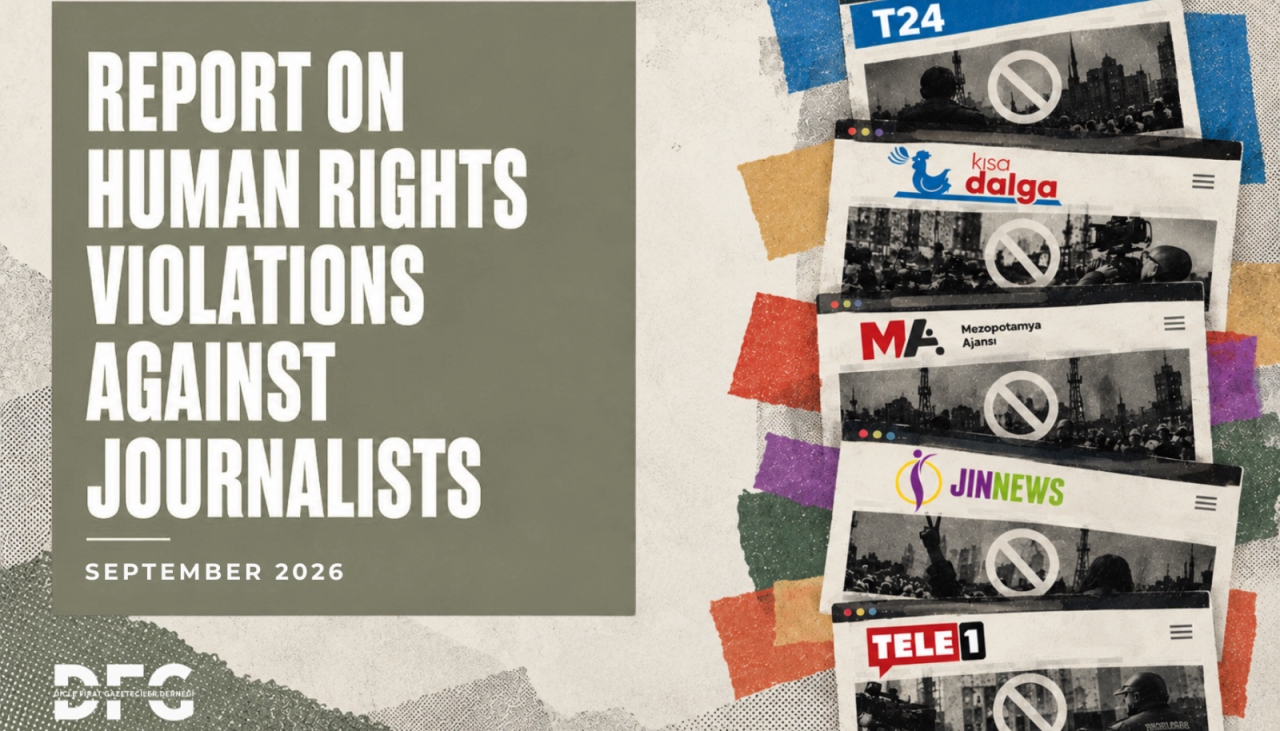
In September, the accounts or websites of media outlets such as JINNEWS, Mezopotamya Agency, Evrensel, Kısa Dalga, and T24 faced access blocks and platform interventions. Furthermore, the personal X accounts of numerous journalists were made invisible from Turkey under pretexts such as “protecting national security and public order.”
The period between September 24 and 30 was particularly notable for the intensity of the access restrictions. The report indicated that on September 24, at least 250 X accounts were blocked; on September 26, another 80 accounts—belonging to media organizations, journalists, academics, and figures in the economics and finance sectors—were blocked. On September 28, access to at least 55 X accounts was blocked, while on September 30, the Freedom of Expression Association’s EngelliWeb project identified that at least 147 more X accounts sharing content about the funding crisis had been blocked.
This concentration also demonstrates that access restrictions are not limited to a specific topic or news story. In September, accounts and content sharing information about the Narin Güran murder, the funding crisis, news regarding public figures, the school attack in Manisa, LGBTI+ rights, political developments, events leading up to the NATO Summit, and various social incidents were subject to access restrictions. The report notes that 99 X accounts were blocked in connection with the Narin Güran investigation, and 92 X accounts were blocked following the school attack in Turgutlu, Manisa.
On September 18, access to the entire Medya Radar website was blocked; following an appeal, this decision was reversed. On September 30, a decision was issued to shut down the T24 website and its X account, which had 1.9 million followers.
This situation demonstrates that access blocks should no longer be viewed merely as a tool to restrict the circulation of specific content. While blocking a news story, making a journalist’s account invisible, shutting down a media outlet’s digital media account, or shutting down an entire news site are different measures, they all produce the same result: the channels through which the public accesses news and through which journalists deliver their stories to the public are being narrowed.
Another significant aspect highlighted by the September data is that access restrictions are not limited solely to administrative and judicial decisions in Turkey. Numerous accounts were made invisible from Turkey by X following the relevant decisions. Instagram, meanwhile, closed the Turkishlanguage account of the Mezopotamya Agency on the grounds of “Community Guidelines” and did not allow for an appeal or a request for reconsideration. JINNEWS’s Turkish-language Instagram account was also suspended in a similar manner.