
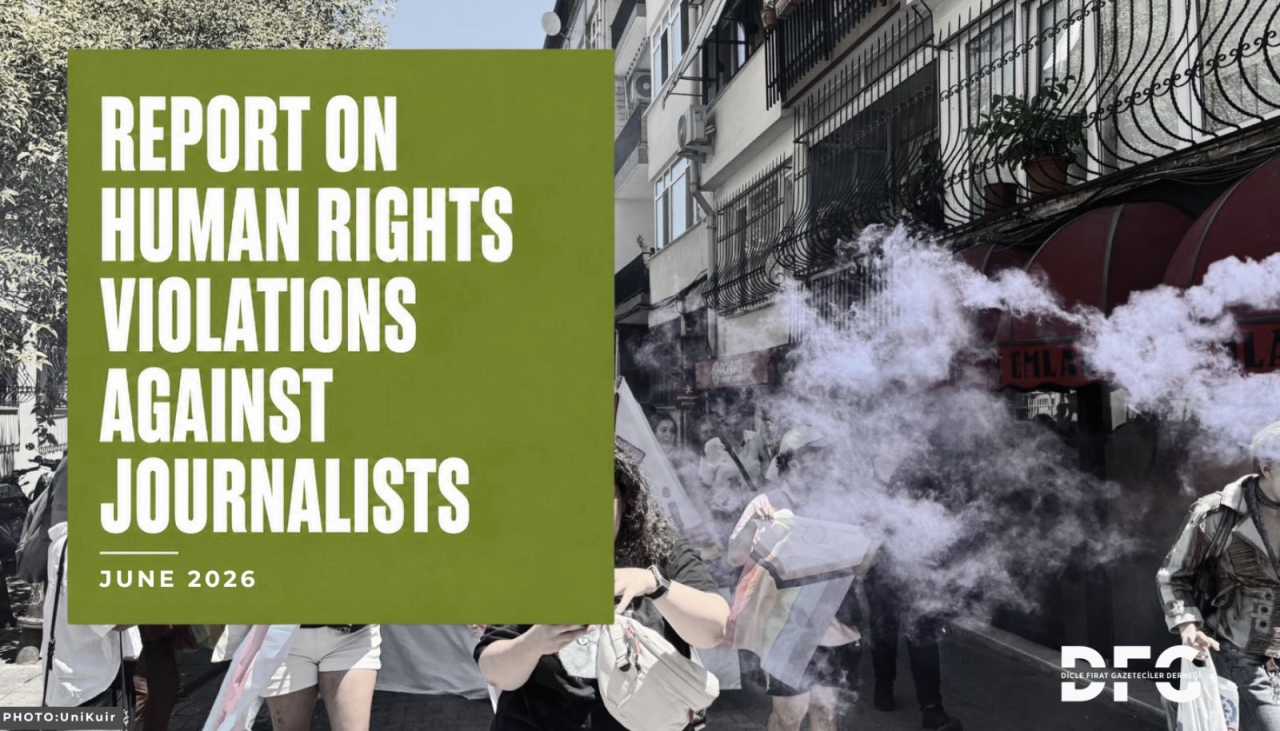
In the month of June, journalists faced multifaceted human rights violations targeting freedom of expression and press freedom. Throughout the month, journalists were subjected to detention, arrest, investigations, and trials, as well as physical attacks, threats, obstruction of news coverage, and various interventions targeting their professional activities. Press and media organizations, meanwhile, came under pressure through administrative sanctions, fines imposed by the Radio and Television Supreme Council (RTÜK), and digital censorship measures. All these violations revealed that journalistic activities continued to be systematically restricted in June and that the crackdown on press freedom persisted.
At least 10 journalists were detained in June, while 4 were arrested. The arrests that took place during the month once again demonstrated that journalistic activities and freedom of expression continue to be suppressed through judicial processes. Yıldız Tar, Editor-in-Chief of KAOS GL, known for her work in the LGBTI+ field, was detained and subsequently arrested following a police raid on her home. Evrensel reporter Doğa Başkan, meanwhile, was arrested at the courthouse where she had gone to give a statement regarding a news story that was published in error and quickly removed from the website.
June was a period marked by intense political and social developments in Turkey. Events commemorating the anniversary of the Gezi Resistance, political debates surrounding the CHP, and the actions of teachers on hunger strike were among the prominent topics throughout the month. Journalists working to report these developments to the public were subjected to verbal and physical attacks, detentions, and targeting while covering the news.
During a police intervention targeting democratic mass organizations that had gathered to commemorate Ethem Sarısülük, who lost his life during the Gezi Resistance, Mezopotamya Agency (MA) reporter Sema Bingöl was beaten and detained. Bingöl was later singled out, along with her family, by the media outlets Akit and Ensonhaber. In these publications, the 15 protests and events Bingöl covered in 2026 were presented as a “criminal record,” despite being part of her journalistic activities. This situation once again demonstrated that journalism in Turkey is being criminalized by shadowy special war units.
Over the course of the month, one journalist was physically assaulted, while two media outlets were targeted. At least three journalists were singled out through various publications and statements. In addition, one journalist was threatened, and four journalists were prevented by security forces from covering news stories.
The judicial system also continued to serve as a key tool for exerting pressure on journalists. During the month, investigations were launched against 9 journalists, and lawsuits were filed against 2 journalists. As a result of the trials, 2 journalists were sentenced to a total of 7 years and 6 months in prison. As of the end of June, the trials of 36 journalists were ongoing in 22 separate cases, and as of July 3, 2026, at least 28 journalists were being held in Turkish prisons.
Violations of journalists’ economic and professional rights also continued. In June, one journalist was fired, one journalist’s press card was revoked, and 19 journalists faced accreditation barriers. These practices continued to pose serious obstacles to journalists’ ability to freely practice their profession.
Administrative sanctions against press and media organizations also continued unabated. The Radio and Television Supreme Council (RTÜK) issued sanctions against nine separate broadcasts. In this context, seven media organizations were fined, while administrative sanctions were imposed on two others.
Censorship practices in the digital sphere also continued intensively in June. Twenty websites were blocked or shut down, access to 43 news articles was restricted, and access restrictions were imposed on 126 social media posts. Thus, not only were journalists’ rights to work seriously violated, but the public’s right to receive news and access information was also severely infringed upon.
The data for June 2026 reveals that the crackdown on journalists is not limited to detentions and arrests; it is being carried out in a multidimensional manner through judicial proceedings, economic sanctions, censorship, and digital access restrictions. The emerging picture shows that the regression in the areas of press and freedom of expression continues, and that journalistic activities are being systematically subjected to pressure.
In June, the press community also suffered a significant loss. Journalist Bayram Balcı, who had been undergoing cancer treatment for nearly seven years, passed away on June 22. Balcı, who dedicated 35 years of his life to the struggle for a free press, participated in numerous actions and events in support of press and freedom of expression; he was detained multiple times and subjected to threats due to his professional activities. We remember Bayram Balcı with respect and fondness for the struggle he waged without compromising on journalistic principles.
DİCLE FIRAT JOURNALISTS’ ASSOCIATION